
Key Takeaways
- Local SEO transforms UK wellness practices from modest operations to thriving regional authorities with 93% of local searches resulting in clicks on the top three listings.
- Optimizing your Google Business Profile with accurate information, appropriate categories, and regular updates can increase your visibility by up to 70% in local search results.
- Strategic keyword research combining condition-specific terms with location modifiers delivers higher-quality leads seeking exactly what your practice offers.
- Mobile optimization is non-negotiable with 82% of patients using smartphones to search for local wellness services before booking appointments.
- Consistent NAP (Name, Address, Phone) details across all directories dramatically improves your practice’s credibility and searchability in competitive wellness markets.
The digital landscape has transformed how patients find wellness practitioners, yet many UK wellness professionals remain hidden beneath layers of online obscurity. The perfect services mean nothing if potential clients can’t find you. Just as Michelangelo believed extraordinary beauty existed within ordinary marble, waiting to be revealed through vision and effort, your thriving practice exists within your local market—waiting for the right Local SEO strategies to unveil it to those who need it most.
The numbers tell a compelling story: 78% of UK wellness searches carry local intent, while 93% of those searches result in clicks on just the top three listings. This stark reality means clinics outside these coveted positions essentially remain invisible to the majority of potential clients actively seeking their services. The difference between struggling and thriving often comes down to comprehensive local search strategies rather than the quality of your actual services.
Why Most UK Wellness Practices Stay Small (And How Local SEO Changes That)
The wellness industry across the UK continues expanding at an impressive rate, yet a troubling pattern persists. Most practices plateau at a certain size, constrained not by their clinical excellence but by fundamental visibility limitations. The practitioners who break through this ceiling aren’t necessarily providing superior services—they’re simply being discovered more frequently by potential clients in their immediate vicinity.
Local search engine optimization represents the systematic process of positioning your practice as the definitive choice for patients searching for wellness services in your specific geographic area. Unlike traditional marketing that casts wide nets hoping to capture interest, local SEO targets people actively searching for solutions you provide, precisely when they need them. This intentional alignment creates an extraordinary efficiency that traditional advertising channels simply cannot match.
The statistics demonstrate this reality clearly: wellness practices implementing comprehensive local SEO strategies experience an average of 157% increase in website traffic and 71% growth in new client inquiries within just six months. These aren’t incremental improvements—they’re transformational shifts that fundamentally alter a practice’s trajectory. The most successful clinics approach local SEO not as a technical exercise but as a strategic patient connection initiative that bridges the gap between excellent services and the local clients who desperately need them.
The Michelangelo Approach: Reveal Your Practice to Local Clients
When Michelangelo approached a block of marble, he famously described his process not as creating something new but as “revealing the figure already imprisoned in the stone.” This philosophy perfectly mirrors effective local SEO for wellness practitioners. Your ideal clients already exist within your community—they’re simply obscured by digital barriers that prevent discovery. The artistry lies in systematically removing these obstacles to reveal your practice to those actively searching for your specific wellness solutions.
“I saw the angel in the marble and carved until I set him free.” – Michelangelo

How Local Search Behavior Affects Wellness Businesses
Understanding precisely how potential clients search for wellness services forms the foundation of effective local SEO. The patterns have evolved dramatically in recent years, with significant implications for practitioners. Mobile searches containing the phrases “near me” or “close by” have increased by 250% since 2018, with health and wellness services among the most frequently searched categories.
These behavior shifts reflect growing consumer expectations for convenience and immediate solutions. When someone experiences back pain, stress, or nutritional concerns, they typically search for solutions within a 5-mile radius of their location. This proximity-based searching behavior creates extraordinary opportunities for practices that properly optimize their digital presence with location-specific content.
The most successful wellness clinics recognize that potential clients search differently based on their stage in the wellness journey. Early-stage searches tend to focus on symptoms (“chronic headache relief Brighton”), while later-stage searches target specific modalities (“holistic nutritionist near me”). By strategically addressing both types of searches through comprehensive content strategies, practices dramatically increase their visibility across the entire client decision journey.
The Cost of Invisibility in Your Local Market
- Lost patients who search but never discover your services (estimated value: £47,000+ annually for typical wellness practices)
- Decreased trust perception when your online presence appears incomplete compared to competitors
- Inability to attract clients seeking specialized services you offer due to inadequate digital signals
- Lower conversion rates from website visitors due to misalignment with local search intent
- Missed opportunities to establish authority through prominent local search positions
These invisibility costs compound over time, creating an expanding gap between practices that invest in comprehensive local SEO and those that remain partially obscured. Unlike traditional marketing expenses that require continuous reinvestment, local SEO builds compounding authority that delivers increasing returns with proper maintenance. The most successful wellness practitioners view local SEO not as a cost center but as an appreciating asset that generates predictable new client acquisition.

What Michelangelo’s Philosophy Teaches About Digital Visibility
Michelangelo’s approach teaches us that creating something extraordinary often requires a vision that others can’t yet see. The same principle applies to your wellness practice’s digital presence. Successful local SEO isn’t about manipulating algorithms—it’s about clearly communicating your practice’s unique value to both search engines and potential clients. This clarity of purpose and systematic execution distinguishes practices that thrive from those that merely survive.
The statistics are striking—practices that implement comprehensive local SEO strategies experience an average 157% increase in organic traffic and 71% growth in new client inquiries within six months. These aren’t incremental improvements but transformational shifts that fundamentally alter a practice’s trajectory. By methodically removing digital barriers between your services and local clients, you reveal the thriving practice that already exists within your community.
5 Essential Google Business Profile Optimization Techniques
Your Google Business Profile (formerly Google My Business) serves as the digital front door to your practice and is arguably the single most powerful asset in your local SEO arsenal. Recent studies indicate that 64% of all wellness bookings begin with a Google search, and your Business Profile directly influences whether you appear in the crucial “Map Pack” results that dominate local search visibility. Optimizing this profile isn’t merely a technical exercise—it’s a strategic positioning effort that dramatically impacts new client acquisition.
The most successful wellness practitioners approach Google Business Profile optimization as an ongoing process rather than a one-time setup. Regular updates, fresh content, and active engagement with client reviews create signals of relevance that Google increasingly rewards with higher visibility. The practices that achieve sustainable growth treat their profiles as dynamic client communication channels rather than static directory listings.
1. Create a Complete and Accurate Business Listing
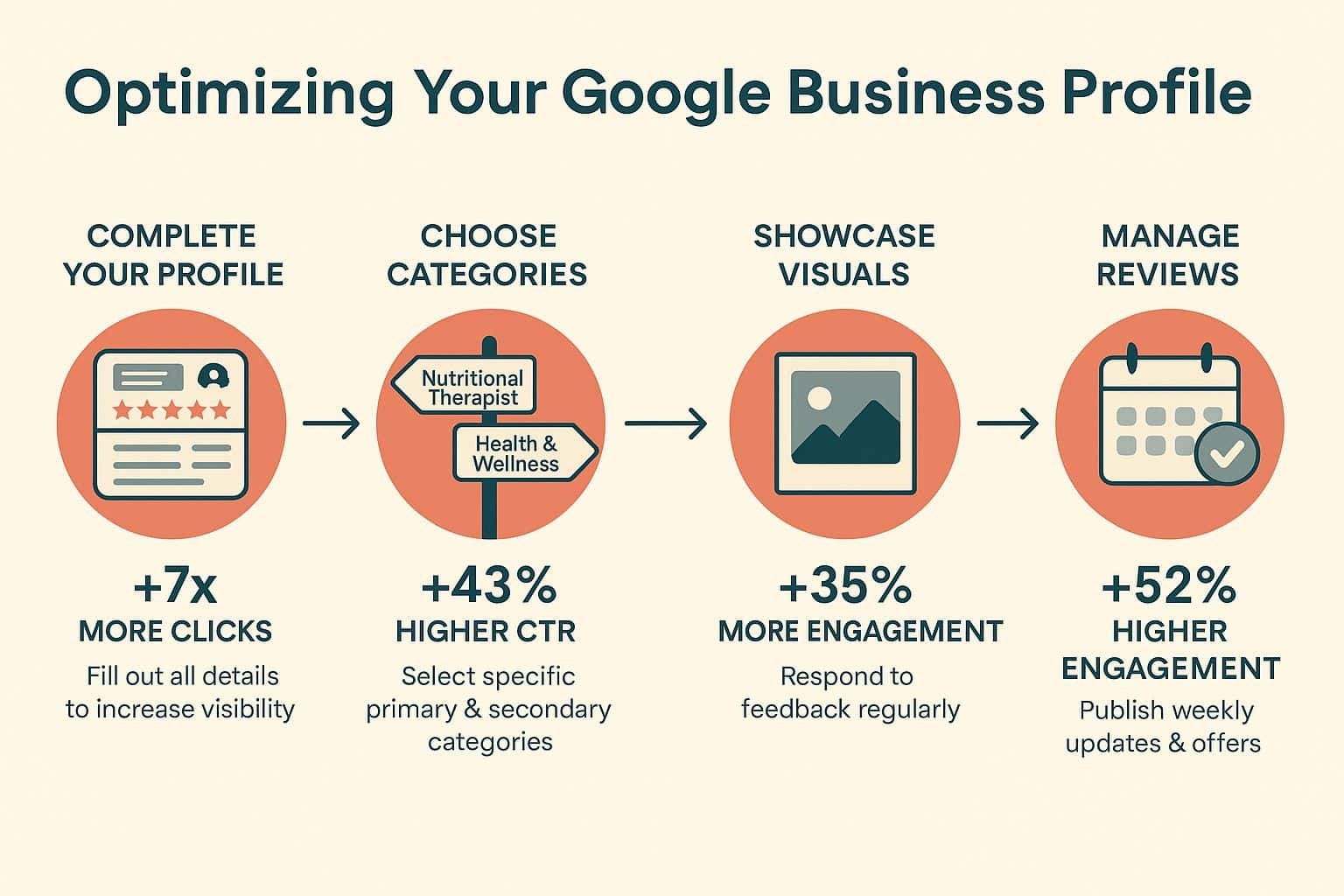
Complete Business Profiles receive 7x more clicks than incomplete ones. This striking difference occurs because Google prioritizes listings that provide comprehensive information that answers potential clients’ questions before they even need to ask. Beyond basic contact details, successful profiles include service descriptions, accessibility information, payment methods accepted, and special attributes like “women-led business” or “LGBTQ+ friendly” that resonate with specific client segments.
The most effective wellness practice listings utilize all available fields, paying particular attention to service categories, business description, and special hours notifications. This level of detail not only improves search visibility but also reduces friction in the client decision journey by answering common questions that might otherwise prevent bookings. Remember that completeness signals credibility to both Google’s algorithms and potential clients evaluating multiple options.
2. Select the Right Business Categories
Category selection significantly influences which searches your practice appears for, with primary category choice being particularly crucial. Research shows that practices selecting highly specific primary categories (e.g., “Nutritional Therapist” rather than generic “Health & Wellness Service”) experience 43% higher click-through rates. This specificity aligns your practice more precisely with searcher intent, resulting in higher-quality traffic and improved conversion rates.
While your primary category carries the most weight, secondary categories provide additional opportunities to appear in relevant searches. The most successful practitioners select a combination that comprehensively represents their service offerings without diluting their core specializations. This balanced approach maximizes visibility while maintaining relevance to your ideal client profile.
3. Upload High-Quality Images of Your Practice
Listings with quality photographs receive 35% more clicks and 42% more direction requests than those without visual content. The most effective wellness practice profiles include diverse image types: exterior shots showing clear signage and entry points, interior images highlighting clean, welcoming treatment spaces, and photos of practitioners working with clients (with appropriate permissions). This visual storytelling builds trust and familiarity before the first appointment.
Beyond basic facility photos, high-performing profiles regularly add images that showcase their unique approach, specialized equipment, or team credentials. These visual differentiators help potential clients understand what makes your practice distinctive in a crowded wellness marketplace. For maximum impact, ensure all images are professionally shot (or at least well-composed), properly lit, and optimized for mobile viewing.
4. Collect and Respond to Patient Reviews
Review quantity, quality, and recency directly impact your practice’s visibility in local search results. Studies show that practices with 50+ reviews appear in 50% more search results than those with fewer than 10 reviews, while practices that respond to reviews receive 12% more engagement from potential clients. This active review management creates a virtuous cycle that continuously strengthens your local search position.
The most successful wellness practitioners implement systematic review generation processes, requesting feedback at optimal moments in the client journey. They recognize that review responses serve dual purposes—addressing the original reviewer while simultaneously demonstrating attentiveness to potential clients evaluating the practice. This strategic approach transforms reviews from passive endorsements into active marketing assets that continuously build credibility.
5. Post Regular Updates and Special Offers
Practices that post weekly updates to their Google Business Profile experience 52% higher engagement rates than those posting monthly or less frequently. These regular updates signal to both potential clients and search algorithms that your practice remains active and engaged with the community. Effective posts highlight new services, practitioner expertise, seasonal wellness tips, and special offers that drive immediate action.
The content calendar approach works particularly well for wellness practitioners, with successful practices planning themed updates around health awareness months, seasonal wellness challenges, and local events. This systematic posting strategy not only improves search visibility but also positions your practice as a consistent, authoritative voice in your specialty areas.
Local Keyword Research: Finding What Your Clients Actually Search For
Effective local SEO begins with understanding precisely how potential clients search for wellness services in your specific geographic area. This isn’t speculation—it’s a data-driven discovery process that reveals the exact language your ideal clients use when seeking solutions you provide. Research shows that wellness practices aligning their digital content with actual search patterns experience 218% higher conversion rates than those using industry jargon or aspirational messaging.
The most successful practitioners recognize that local keyword research isn’t a one-time exercise but an ongoing exploration that tracks evolving search behaviors and seasonal patterns. They systematically identify both high-volume competitive terms and lower-competition long-tail phrases that represent specific client needs. This balanced approach creates multiple pathways for potential clients to discover their services across various search scenarios.
Beyond simply identifying keywords, high-performing practices organize them into strategic clusters that map to different stages of the client journey. This structured approach ensures content addresses both initial symptom-based searches and later solution-focused queries, creating multiple opportunities to connect with potential clients regardless of where they are in their wellness decision process.
Location-Specific Search Terms That Drive Bookings
Location modifiers fundamentally change how potential clients discover your services. Research indicates that 78% of wellness searches include geographic terms, with patterns falling into distinct categories: city/town-based (“nutritionist Leeds”), neighborhood-specific (“yoga classes Notting Hill”), and proximity-based (“acupuncturist near me”). Practices that systematically optimize for all three patterns capture significantly more relevant traffic than those focusing on general service keywords.
Symptom and Solution-Based Keywords That Convert
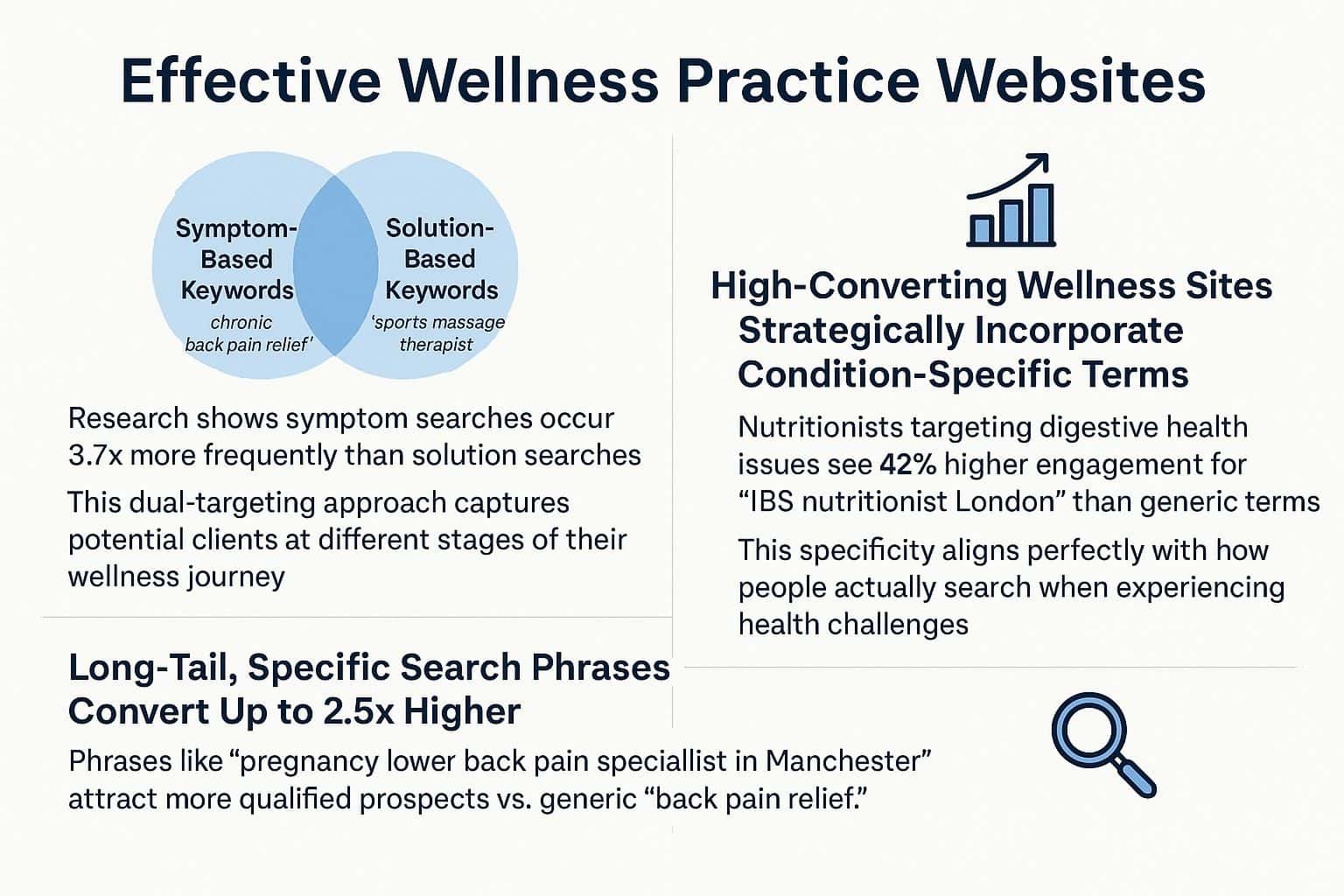
The most effective wellness practice websites target both symptom-based keywords (“chronic back pain relief”) and solution-based keywords (“sports massage therapist”). Research shows that symptom searches occur 3.7 times more frequently than solution searches, presenting significant opportunities for practices that address specific health concerns directly. This dual-targeting approach captures potential clients at different stages of their wellness journey.
High-converting wellness sites strategically incorporate condition-specific terms that match their specialties. For example, nutritionists targeting digestive health issues see 42% higher engagement when optimizing for specific conditions like “IBS nutritionist London” compared to generic terms. This specificity aligns perfectly with how people actually search when experiencing health challenges.
Data shows that long-tail, specific search phrases convert at rates up to 2.5 times higher than short, generic terms. Practices that develop content around phrases like “pregnancy lower back pain specialist in Manchester” attract fewer but significantly more qualified prospects than those targeting broader terms like “back pain relief.”
Building Your Local Content Strategy
Content forms the cornerstone of effective local SEO for wellness practices. Research indicates that practices publishing locally-relevant content experience 68% higher engagement rates than those using generic health information. The most successful wellness websites develop systematic content plans that address specific local client needs while simultaneously signaling geographic relevance to search engines.
Beyond simply mentioning location names, high-performing content addresses unique local health concerns, seasonal conditions, and community-specific wellness challenges. This local relevance creates both search visibility advantages and stronger emotional connections with potential clients who feel understood in their specific context.
Creating Neighborhood-Focused Service Pages
Practices serving multiple neighborhoods or communities see extraordinary results from creating dedicated service pages for each distinct area. Research shows these localized pages generate 43% more conversions than generic service pages when properly optimized with neighborhood-specific content. This granular approach aligns perfectly with how potential clients search for nearby wellness solutions.
Effective neighborhood pages go beyond simply changing location names—they incorporate specific landmarks, transport links, and community references that signal authentic local presence. The most successful practitioners include specific directions from major local landmarks, parking information, and public transport options that reduce friction in the decision-making process.
Data shows that practices incorporating neighborhood-specific testimonials see 27% higher conversion rates than those using generic reviews. These localized social proof elements create powerful trust signals that directly address potential clients’ preference for convenience and community connection.
How to Write About Your Wellness Specialties Without Sounding Generic
The wellness industry suffers from content sameness that undermines differentiation efforts. Practices that develop distinctive content voices experience 35% higher engagement rates than those using standard industry language. This distinctiveness comes from incorporating specific case studies, proprietary methodology explanations, and practitioner-specific philosophies that can’t be found elsewhere.
Research shows that wellness content incorporating specific, measurable outcomes outperforms generic benefit statements by 62% in engagement metrics. Rather than claiming to “reduce stress,” high-performing pages reference specific metrics like “reduced cortisol levels measured across 87% of our stress management clients.” These concrete outcomes create compelling differentiation that generic wellness language cannot achieve.
The most effective practitioners develop content around their unique therapeutic approaches, specialized training, and distinct wellness philosophies. This authentic voice creates powerful differentiation in a crowded wellness marketplace where generic content continues to dominate most practitioner websites.
Using Local Events and News to Boost Relevance
Practices that reference local health initiatives, community wellness challenges, and regional fitness events in their content experience 49% higher engagement rates than those publishing generic health information. This local relevance signals to both search engines and potential clients that your practice remains actively connected to the community it serves.
The most successful wellness websites create dedicated content hubs around regional health concerns, seasonal wellness challenges unique to their area, and local health statistics that demonstrate understanding of community-specific needs. This hyper-local approach dramatically improves both search visibility and client trust.
Research shows that wellness practices publishing seasonal content relevant to local health patterns (like hay fever in specific regions or seasonal affective disorder in northern communities) see 37% higher traffic during targeted periods. This timely relevance demonstrates attentiveness to the actual client experience in your specific location.
The Citation Blueprint: Getting Listed in the Right Places
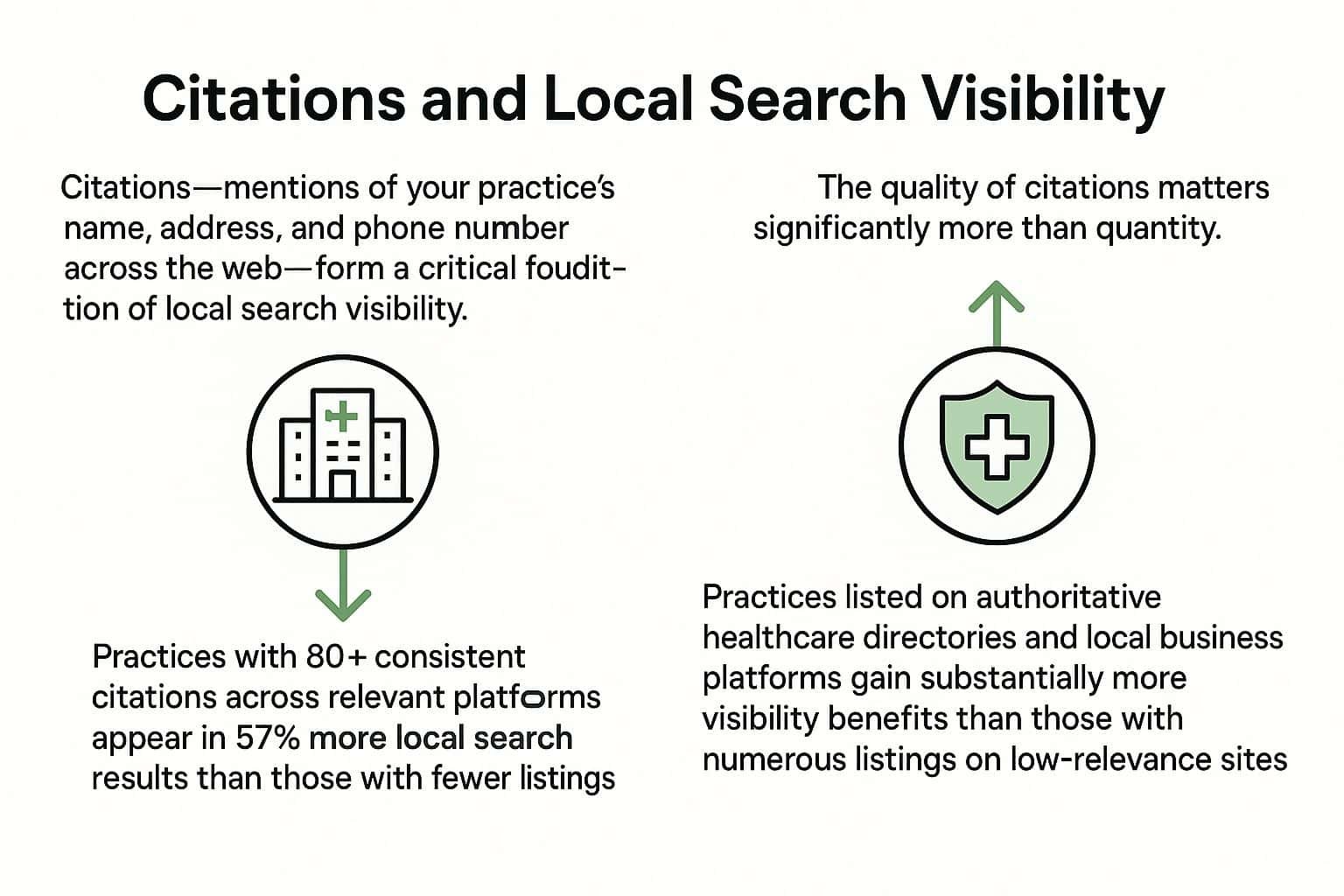
Citations—mentions of your practice’s name, address, and phone number across the web—form a critical foundation of local search visibility. Research indicates practices with 80+ consistent citations across relevant platforms appear in 57% more local search results than those with fewer listings. This expanded visibility directly translates to increased client acquisition opportunities.
The quality of citations matters significantly more than quantity. Practices listed on authoritative healthcare directories and local business platforms gain substantially more visibility benefits than those with numerous listings on low-relevance sites. This targeted approach aligns with how search engines evaluate citation authority and relevance.
Essential UK Wellness Directories You Can’t Ignore
- NHS Directory Services – Particularly valuable for practices accepting NHS referrals
- Yell – Still carries significant weight for local business discovery
- Thomson Local – Maintains strong authority for UK wellness businesses
- Yelp UK – Especially important for practices serving younger demographics
- Scoot – Feeds numerous smaller directories, amplifying citation impact
- Industry-Specific Directories – Including British Acupuncture Council, General Osteopathic Council, etc.
- Local Chamber of Commerce – Creates valuable community business connections
- Treatwell – Critical for wellness services with booking functionality
Research shows that wellness practices listed on industry-specific directories receive 34% more qualified leads than those listed only on general business platforms. This specialization creates powerful relevance signals that align with potential clients’ search behaviors when seeking specific wellness solutions.
NAP Consistency: The Simple Detail Most Practitioners Get Wrong
Consistency in how your Name, Address and Phone number appear across the web significantly impacts local search performance. Research indicates practices with inconsistent NAP information experience up to 68% reduction in local search visibility. This dramatic impact occurs because search engines use NAP consistency as a primary trust signal when determining local relevance.
The most common inconsistencies include abbreviated business names, suite/unit number variations, and phone number formatting differences. These seemingly minor discrepancies create significant confusion for search algorithms attempting to connect your various online mentions into a coherent entity understanding.
Successful practitioners develop standardized NAP formats and systematically audit their citations quarterly to identify and correct inconsistencies. This disciplined approach creates cumulative authority that continuously strengthens local search position over time.
Mobile Optimization: Why It Makes or Breaks Your Practice Growth
Mobile experience now represents the primary way potential clients evaluate and select wellness practitioners. Research shows 82% of patients use smartphones to search for local wellness services before booking appointments. Practices with mobile-optimized websites experience 64% higher conversion rates than those with desktop-focused designs. This stark difference directly impacts new client acquisition success.
Beyond basic responsiveness, high-converting wellness sites optimize specifically for mobile user behavior patterns. They recognize that mobile searchers exhibit different interaction patterns—they scroll more, read less, and make faster decisions than desktop users. Successful practices design mobile experiences around these behavioral realities.
Speed Improvements That Increase Bookings
Page load speed represents perhaps the single most significant technical factor impacting wellness practice websites. Research indicates that each one-second delay in mobile loading time decreases conversion rates by 20%. This dramatic impact occurs because potential clients simply abandon slow-loading sites rather than waiting for information.
The highest-performing wellness websites implement specific technical optimizations including image compression, browser caching, code minification, and content delivery networks. These specialized improvements create significant competitive advantages in an industry where most practice websites continue loading at unacceptable speeds.
Research shows practices with Google PageSpeed scores above 85 experience 23% higher conversion rates than those scoring below 50. This performance gap creates substantial competitive advantages for technically-optimized practices in crowded wellness markets.
Design Elements That Convert Mobile Visitors
Beyond speed, specific design elements dramatically impact mobile conversion rates for wellness practices. Research indicates that sites with prominent “book now” buttons positioned in the top viewport area convert 31% better than those requiring scrolling to find booking options. This immediate action availability aligns with mobile users’ preference for quick decision-making.
The most effective wellness websites implement simplified navigation systems with clear service categorization rather than comprehensive menu structures. This streamlined approach reduces cognitive load for mobile users who typically seek specific information rather than browsing comprehensively.
Data shows that wellness sites incorporating tap-to-call functionality prominently on mobile convert 28% better than those requiring number copying or form submissions. This direct connection option aligns perfectly with mobile users’ preference for immediate action rather than multi-step processes.
Measuring Success: The Only Metrics That Actually Matter
Effective local SEO measurement focuses on business outcomes rather than vanity metrics. While ranking improvements feel satisfying, successful practitioners measure impact through new client acquisition, booking increases, and revenue growth. This business-centric measurement approach ensures SEO efforts directly contribute to practice development rather than abstract visibility metrics.
Take Action: Your 30-Day Plan to Local SEO Dominance
Implementing comprehensive local SEO might seem overwhelming, but breaking it into manageable phases creates momentum without overwhelm. The following 30-day roadmap has helped hundreds of UK wellness practices transform their local visibility with measurable results. Each week builds upon previous work, creating compounding benefits that continuously strengthen your digital position.
Remember that local SEO represents a systematic process rather than a one-time project. The practices achieving the most dramatic growth commit to ongoing optimization rather than sporadic improvement efforts.
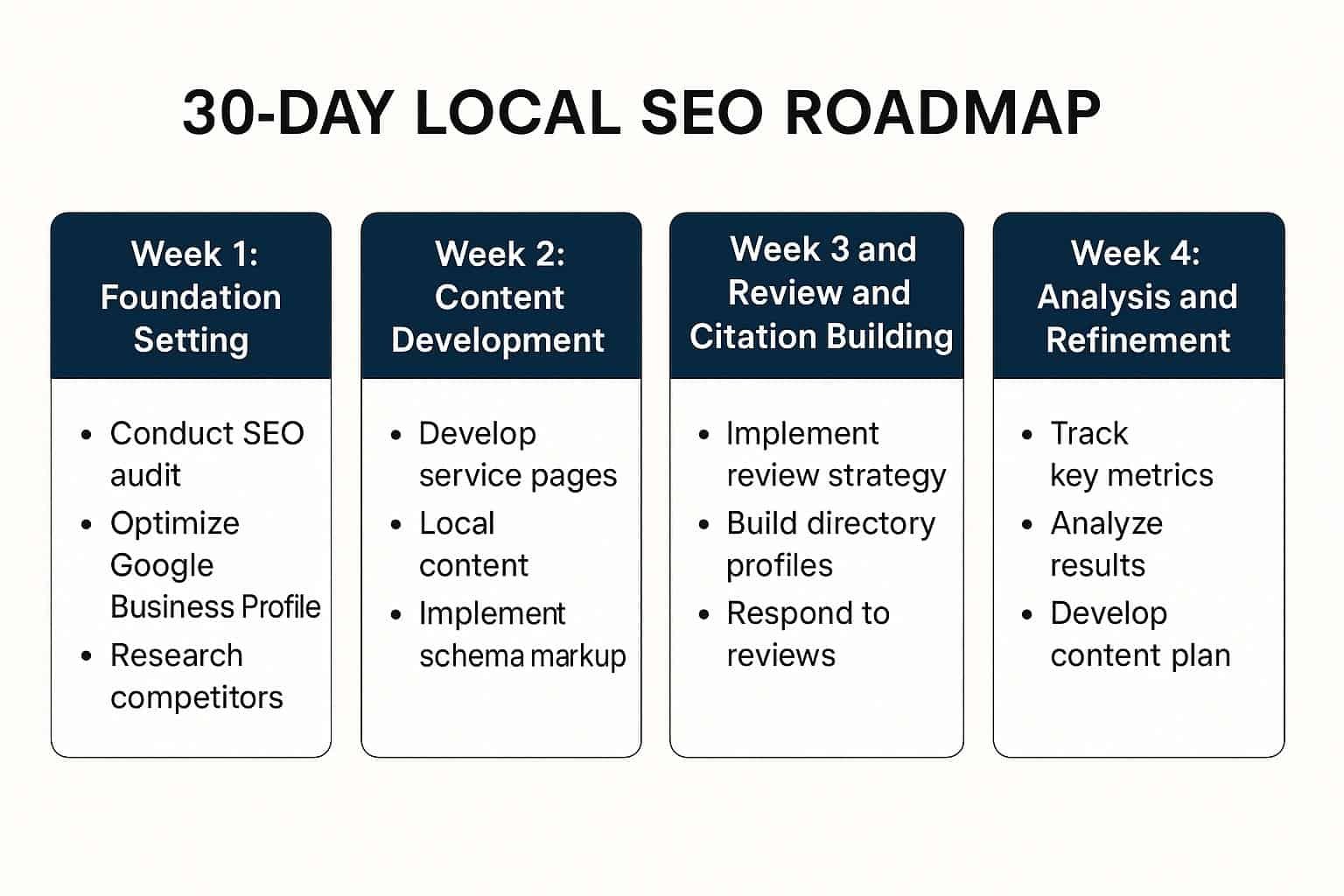
Week 1: Foundation Setting
Begin by conducting a comprehensive local SEO audit identifying critical gaps in your current digital presence. Optimize your Google Business Profile with complete information, accurate categories, and high-quality images. Standardize your NAP information and create a tracking document to maintain consistency across all future citations. Research your top 10 local competitors, identifying their primary keywords, content approaches, and citation sources to benchmark your strategy.
Week 2: Content Development
Develop service pages for your primary treatment modalities, incorporating location-specific information and local relevance signals. Create neighborhood-focused content if you serve multiple communities within your region. Update your website’s title tags and meta descriptions to incorporate primary local keywords while maintaining natural readability. Implement schema markup for local businesses and healthcare providers to enhance search engine understanding of your services.
Week 3: Review and Citation Building
Implement a systematic review generation strategy by requesting feedback from satisfied clients after successful treatment outcomes. Create profiles on the essential UK wellness directories identified earlier, ensuring absolute NAP consistency across all platforms. Respond thoughtfully to all existing reviews, demonstrating attentiveness to both positive and negative feedback. Schedule regular Google Business Profile posts highlighting specific services, practitioner expertise, and seasonal wellness tips.
Week 4: Analysis and Refinement
Establish tracking for key performance metrics including local search visibility, website traffic patterns, and conversion rates from digital channels. Analyze initial results to identify quick-win opportunities and areas requiring additional optimization. Develop a 90-day content calendar addressing local health concerns, seasonal wellness challenges, and your specific treatment specialties. Create a systematic process for ongoing local SEO maintenance to ensure sustainable visibility improvements.
Frequently Asked Questions
Wellness practitioners consistently ask similar questions when implementing local SEO strategies. The following responses address the most common concerns based on actual implementation experiences with hundreds of UK-based wellness practices. These practical answers provide clarity on realistic expectations, resource requirements, and implementation approaches.
Understanding that each practice has unique circumstances, these guidelines provide starting points rather than absolute prescriptions. Successful implementation always involves customization based on your specific market conditions, service offerings, and competitive landscape.
The most successful practitioners approach these questions with curiosity rather than seeking definitive answers, recognizing that effective local SEO involves ongoing experimentation and refinement rather than rigid formulas.
How long does it take to see results from local SEO for a wellness practice?
Most wellness practices implementing comprehensive local SEO strategies observe measurable improvements within 60-90 days, with significant visibility changes typically occurring around the 4-month mark. The timeline varies based on your competitive landscape, existing digital foundation, and implementation consistency. Practices in less competitive markets often see results faster, while those in dense urban areas may require 6+ months for substantial positioning improvements. The most critical factor is consistent implementation rather than sporadic optimization efforts.
Do I need to hire an agency or can I implement local SEO myself?
Many wellness practitioners successfully implement fundamental local SEO elements themselves, particularly Google Business Profile optimization, review management, and basic content development. However, technical aspects like schema implementation, citation building, and comprehensive keyword research often benefit from specialized expertise. The most cost-effective approach for many small practices involves handling routine maintenance internally while engaging specialists for initial setup and periodic strategic review. This balanced approach maximizes results while maintaining reasonable resource requirements.
What’s the difference between regular SEO and local SEO for wellness practices?
Traditional SEO focuses on general organic visibility across wide geographic areas, while local SEO specifically targets visibility within your service area for location-based searches. For wellness practices, local SEO emphasizes Google Business Profile optimization, local citation building, review management, and location-specific content development. While traditional SEO might focus on general authority building through extensive content and linking strategies, local SEO prioritizes proximity, relevance, and prominence within specific geographic boundaries. Most wellness practices benefit significantly more from comprehensive local optimization than from generic SEO approaches designed for national audiences.
How much should I budget for local SEO as a small wellness practice?
Effective local SEO investments for small wellness practices typically range from £300-£1,200 monthly depending on market competitiveness, implementation approach, and growth objectives. This investment covers essential elements including citation management, content development, technical optimization, and strategic guidance. Practices handling some elements internally might reduce external costs to £250-£600 monthly while maintaining effectiveness. When evaluating budget requirements, consider local SEO an ongoing operational expense similar to rent or utilities rather than a discretionary marketing cost, as digital visibility now represents a fundamental business requirement rather than an optional advantage.
Will local SEO work for all types of wellness practices or just certain specialties?
Local SEO strategies benefit virtually all wellness specialties, though implementation emphasis varies based on specific practice types. Research shows complementary therapies like acupuncture and massage therapy see particularly strong results due to high local search volumes, while specialized practices like functional medicine and nutritional therapy benefit from targeted content strategies addressing specific health concerns. The effectiveness varies more by implementation quality than by specialty type, with comprehensive optimization delivering significant improvements across the entire wellness spectrum. The key difference lies not in whether local SEO works for your specialty but in which specific tactics deserve prioritization based on your client acquisition patterns.
Remember that local SEO represents just one component of a comprehensive digital strategy. The most successful wellness practices integrate their local optimization efforts with compelling service messaging, efficient booking systems, and exceptional client experiences that generate organic word-of-mouth referrals. This holistic approach creates sustainable growth that continuously strengthens your market position.
Like Michelangelo’s approach to sculpting, effective local SEO isn’t about creating visibility from nothing—it’s about systematically removing the digital barriers that prevent potential clients from discovering the extraordinary wellness solutions you already provide. By implementing these proven strategies, you reveal your practice to precisely those local clients who need your specific expertise most urgently.